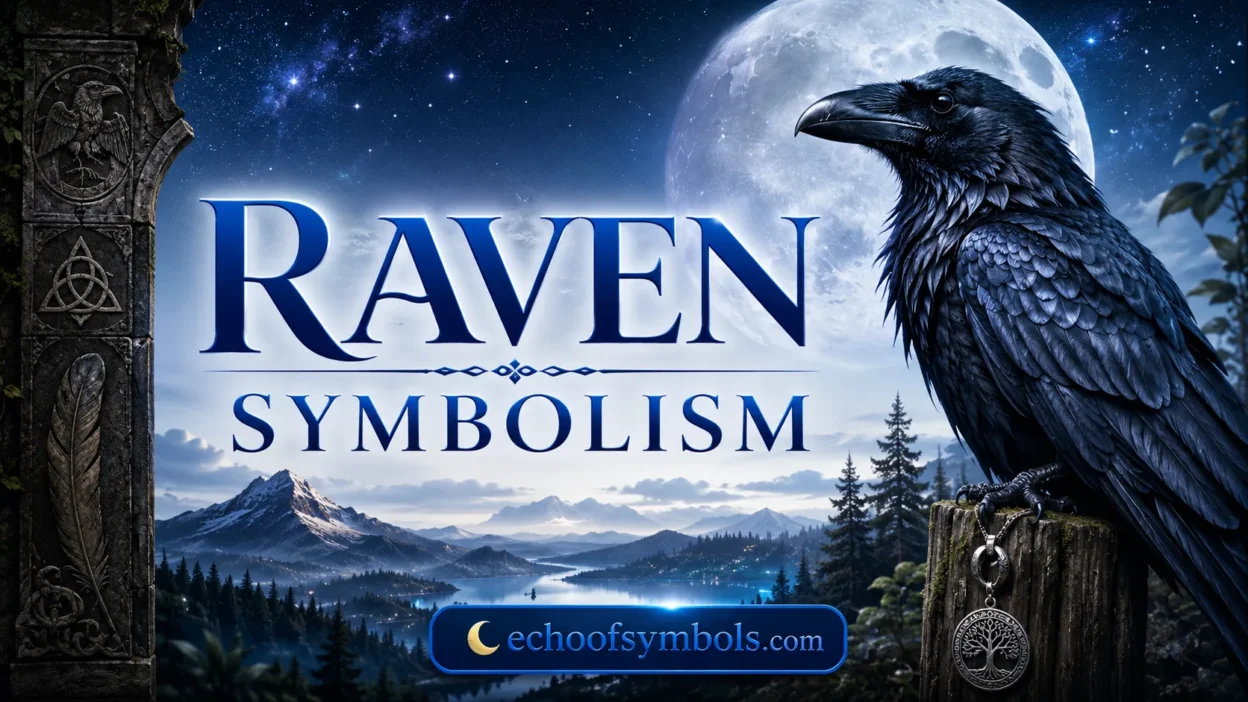
Raven symbolism reveals fascinating hidden meanings connected with wisdom, transformation, and spiritual guidance. Many people explore raven spiritual meaning during life changes, seeking clarity, truth, and inner guidance.
This highly intelligent bird from the corvid family, recognized by glossy black feathers and dark wings, inspires lasting curiosity. Across mythology, folklore, legends, and cultural symbolism, the mystical bird represents ancient wisdom, mystical wisdom, and timeless knowledge.
Whether appearing in dreams, a nature walk, or a surprising raven encounter, this black bird often becomes a spiritual messenger carrying divine messages from the spiritual realm. Many spiritual traditions, including Native American symbolism, Norse mythology, Celtic mythology, Japanese mythology, Christian symbolism, and American culture, honor the raven as a spiritual guide, guardian, and protector.
This guide explores raven meaning, raven spirit animal, raven totem, and raven power animal, explaining their connection to personal growth, self-discovery, spiritual awakening, higher awareness, and spiritual exploration.
Also Read This: 3 Knocks Symbolism and Spiritual Meaning
Quick Answer
In raven symbolism and spiritual meaning, the bird mainly stands for mystery, transformation, and wisdom. In the USA, it often connects to intelligence, memory, and the unknown, shaped heavily by Poe’s poetry. Around the world, it can also represent prophecy, guidance, and a bridge between the living and spirit worlds.
TL;DR
• The raven symbolizes mystery, wisdom, and deep transformation.
• Ancient cultures linked ravens to gods, prophecy, and messages.
• In the USA, Poe’s poem shaped much of the raven’s meaning.
• Native American traditions often see the raven as a trickster.
• Modern fans use raven imagery in tattoos, art, and decor.
• Meanings shifted from pure omen to symbol of insight.
What the Raven Symbol Really Represents
Before looking at history, it helps to understand what the raven looks like as a symbol. This overview matters because the raven’s appearance shapes how people read its meaning.
Artists and writers usually show ravens in a few classic ways. Each detail carries its own message, and Americans quickly recognize these visual cues in art, tattoos, and stories.
• Glossy black feathers often connect the raven to mystery and depth.
• A sharp, watchful eye suggests intelligence and quiet observation.
• A raven perched alone can signal solitude or deep thought.
• A loud call or croak is tied to warning or announcement.
• Wings spread in flight often represent freedom and transition.
Historical Background and Ancient Roots
Raven symbolism did not start with modern poetry or tattoos. It goes back thousands of years, long before Christianity spread across Europe. Understanding these roots helps explain why the raven still feels so meaningful today.
Ancient and Pre-Christian Views
In many early societies, ravens lived close to human settlements and often followed hunters or warriors. Because of this closeness, people built myths around ravens to explain their sharp behavior and dark appearance.
Some ancient cultures honored the raven as a wise messenger. Others feared it as a sign of death or bad luck. Both views shaped the layered symbolism the raven carries today.
Mythology and Legend
• Norse mythology features Huginn and Muninn, Odin’s ravens of thought and memory.
• Celtic myth ties the raven to the goddess Morrigan and battle.
• Greek legend links the raven to prophecy and the god Apollo.
• Old Testament scripture describes ravens providing food to Elijah.
Raven Symbolism in the USA
The raven holds a distinct place in American culture. Its meaning here is closely tied to literature, art, and a long history of mixed feelings about the bird.
Edgar Allan Poe’s 1845 poem, simply called “The Raven,” left a lasting mark on American symbolism. Because of Poe’s influence, many people still connect the bird to loss, memory, and haunting mystery.
However, attitudes have grown more balanced over time. Today, many Americans also view the raven as a symbol of sharp intelligence and quiet strength.
• The raven often represents mystery and the unknown in American art.
• It stands for intelligence, since ravens are known for problem-solving.
• Many see it as a symbol of transformation or a turning point.
• It also reflects deep memory and reflection, tied to Poe’s legacy.
Raven Symbolism at a Glance: A Quick Reference Table
This table breaks down a few common raven images and what they tend to mean in the USA today.
| Context | Meaning in the USA | Common Associations | Notes |
| Solo perched raven | Deep thought and quiet wisdom | Solitude, reflection, patience | Popular in minimalist tattoos |
| Raven in flight | Transformation and freedom | Change, new beginnings, release | Common in decor and art prints |
| Raven pair | Thought and memory | Balance of mind and reflection | Nods to Norse mythology themes |
| Croaking raven | A warning or message arriving | Alertness, communication | Frequent in folklore and stories |
| Raven at night | Mystery and the unknown | Shadow, intuition, the unseen | Tied to Poe-inspired imagery |
Ravens in Native American Culture and Spirituality
Raven symbolism runs especially deep in many Native American traditions, particularly among Pacific Northwest tribes. Different tribes hold different stories, but several themes appear again and again.
For many tribes, the raven is a trickster, creator, or shape-shifter. Tlingit and Haida stories often describe the raven as the being who brought light or shaped the world through cunning.
• The raven often appears as a clever trickster who teaches through mistakes.
• Many tribes credit the raven with acts of creation or transformation.
• The raven is sometimes seen as a bridge between worlds.
• Totem poles and carvings frequently honor the raven’s creative role.
It’s worth noting that beliefs vary widely between tribes and nations. No single story speaks for all Native American views of the raven, so it’s best to treat these teachings with respect rather than as one unified belief system.
Raven Symbolism in Norse and Celtic Mythology
Outside North America, European folklore gives the raven a commanding presence. This context matters because it explains why Americans often link the bird to wisdom and prophecy.
In Norse mythology, Odin relied on his two ravens to gather knowledge from across the world. In Celtic tradition, the raven’s ties to battle and prophecy gave it a serious, almost sacred weight.
• Huginn and Muninn represented thought and memory for Odin.
• The Celtic goddess Morrigan often appeared in raven form.
• Ravens on a battlefield were seen as omens of coming events.
• These myths helped shape the raven’s image as a wise messenger.
Cross-Cultural and Global Spiritual Meanings
Beyond Europe and North America, many cultures around the world see the raven in a spiritual light. These views are worth a brief look, since they often shape how Americans interpret raven imagery today.
• Norse tradition ties the raven to divine knowledge and memory.
• Native American lore often casts the raven as a clever creator.
• Biblical scripture presents the raven as a provider in hard times.
• Some East Asian traditions link ravens to the sun and guidance.
Across these traditions, the raven’s dual nature stands out. It is both a messenger and a warning, wise and mysterious. This balance is part of why raven symbolism feels so rich and layered.
Emotional and Psychological Meaning of the Raven
Beyond history and culture, the raven touches something personal for many people. Its symbolism often mirrors emotions and values that feel very human.
Because ravens are seen as sharp and observant, people relate their own instincts and inner voice to the bird. This is one reason raven imagery feels so personal to many Americans.
• A pull toward deep thought and honest self-reflection.
• Comfort with change, even when the outcome feels uncertain.
• A quiet respect for intelligence and careful observation.
• A sense of mystery, curiosity, and attraction to the unknown.
• A reminder to look past the surface of a situation.
Raven Spirit Animal and Totem Meaning
Many people today use the phrase spirit animal or totem to describe a personal connection with the raven. This modern spiritual use borrows loosely from older traditions, so it’s worth explaining on its own.
When someone says the raven is their spirit animal, they usually mean it reflects their curiosity, intuition, or readiness for change. For example, someone facing a big life shift might feel drawn to raven imagery.
• A raven spirit animal often signals a coming transformation.
• It can point to hidden truths that are ready to surface.
• Some see it as encouragement to trust their intuition.
• Others read it as a nudge to embrace the unknown calmly.
Raven Symbolism in Dreams
Dreaming about a raven is common, and people often want to know what it means. While dream meanings are personal, a few themes come up again and again.
• A calm raven in a dream may reflect insight or clarity arriving.
• A raven circling overhead might point to an approaching decision.
• Multiple ravens in a dream can suggest layered or complex thoughts.
• A raven speaking or croaking often relates to an important message.
These interpretations are not fixed rules. Instead, they offer a starting point for personal reflection, and many people find it helpful to journal about the feelings a raven dream brings up.
Modern Usage: Tattoos, Fashion, and Social Media
Today, raven symbolism shows up everywhere in daily life. This section looks at how Americans use raven imagery in style, art, and online spaces.
Tattoos and Fashion
Raven tattoos remain a popular choice in the USA, often tied to literature and personal transformation. People frequently choose them to mark a turning point or a love of mystery and depth.
• Poe-inspired raven tattoos often nod to loss or deep memory.
• Flying raven designs can represent freedom or a fresh start.
• Minimalist raven silhouettes are popular for a modern, clean look.
• Raven jewelry and accessories often lean on themes of wisdom.
Social Media and Pop Culture
Online, raven imagery pairs naturally with themes of mystery and intellect. Movies, books, and shows featuring ravens keep this symbolism alive for new generations.
• Raven-themed usernames and avatars suggest depth and intelligence.
• Gothic and dark academia trends often feature raven imagery.
• Fantasy shows and books use ravens as messengers or omens.
• Poetry accounts frequently reference Poe’s raven in modern posts.
Raven Symbolism, Holidays, and American Identity
Ravens are not tied to one specific American holiday, but their symbolism connects to broader seasonal and cultural themes. This link helps explain why the bird still resonates so strongly.
Because of their dark feathers and quiet presence, ravens often appear around autumn and Halloween imagery. This timing reinforces their link to mystery and the unknown in American pop culture.
• Ravens frequently appear in autumn and Halloween decorations.
• Literature classes across the USA still study Poe’s famous poem.
• Sports teams and brands use the raven to project sharp intelligence.
• The bird has become a quiet symbol of gothic and literary style.
Misunderstandings, Misuse, and Controversies
Like many powerful symbols, the raven can be misunderstood or oversimplified. It helps to separate traditional, layered meanings from flattened stereotypes.
Most raven symbolism centers on wisdom, transformation, and mystery. However, popular culture sometimes reduces the bird to a simple sign of death or bad luck, which overlooks its full history.
This narrow view does not reflect the traditional or spiritual meaning of the raven. It’s important to recognize context. A raven in a poem, a Native American story, or a piece of jewelry carries very different weight than one used as a shallow horror cliche.
• Traditional raven symbolism includes wisdom, not just doom.
• Horror media often oversimplifies the raven as a bad omen.
• Native American meanings deserve separate, respectful attention.
• Context matters more than the bird’s color or appearance alone.
How Raven Symbolism Has Shifted Over Time
Raven symbolism has changed a great deal across history. Looking at this shift helps explain why older and newer meanings can feel so different.
In earlier centuries, the raven was mostly linked to death, omens, and warning. Over time, growing interest in bird intelligence and mythology reshaped that view into one of respect and curiosity.
• Fear-based views of ravens are now less common than in past centuries.
• Interest in raven intelligence has grown through nature documentaries.
• Literary and spiritual meanings have blended in modern culture.
• Raven symbolism today mixes ancient myth with personal reflection.
FAQs
What does raven symbolism and raven spiritual meaning represent?
Raven symbolism is commonly linked with wisdom, transformation, truth, clarity, and personal growth. Many people believe the raven spiritual meaning reflects divine messages, inner guidance, and a deeper connection with the spiritual realm during important life changes.
What does it mean when a raven crosses your path?
A raven crossing your path is often viewed as a meaningful symbolic appearance from a spiritual messenger or spiritual guide. It may encourage self-discovery, spiritual awakening, higher awareness, and paying attention to universe messages and cosmic messages.
What is the difference between a raven spirit animal, raven totem, and raven power animal?
A raven spirit animal inspires intuition, creativity, and resourcefulness throughout your life journey. A raven totem reflects lasting personal traits, while a raven power animal offers strength, protection, and empowered freedom during challenges and personal transformation.
What does seeing a raven in dreams or a raven at your window mean?
A raven in dreams often relates to dream symbolism, dream interpretation, hidden meanings, and messages from the unseen realm. A raven at your window may symbolize a connection between the physical realm and the living and unseen, encouraging reflection and spiritual exploration.
How is raven symbolism understood across different cultures?
Raven symbolism across cultures appears in Native American symbolism, Norse mythology, Celtic mythology, Japanese mythology, and Christian symbolism. These spiritual traditions often describe the raven as a guardian, protector, sacred bird, mystical bird, and keeper of ancient wisdom and timeless knowledge.
Conclusion
Whether you view raven symbolism through mythology, folklore, or spiritual traditions, its message continues to inspire wisdom, transformation, and personal growth. Understanding raven spiritual meaning can strengthen your inner guidance, encourage self-discovery, and deepen your connection with the spiritual realm.
From a meaningful raven encounter to powerful dream symbolism, this mystical bird reminds us to embrace change with clarity, truth, and higher awareness. By exploring raven meaning, you can appreciate its lasting role as a spiritual guide, guardian, and timeless symbol of spiritual exploration and life journey.