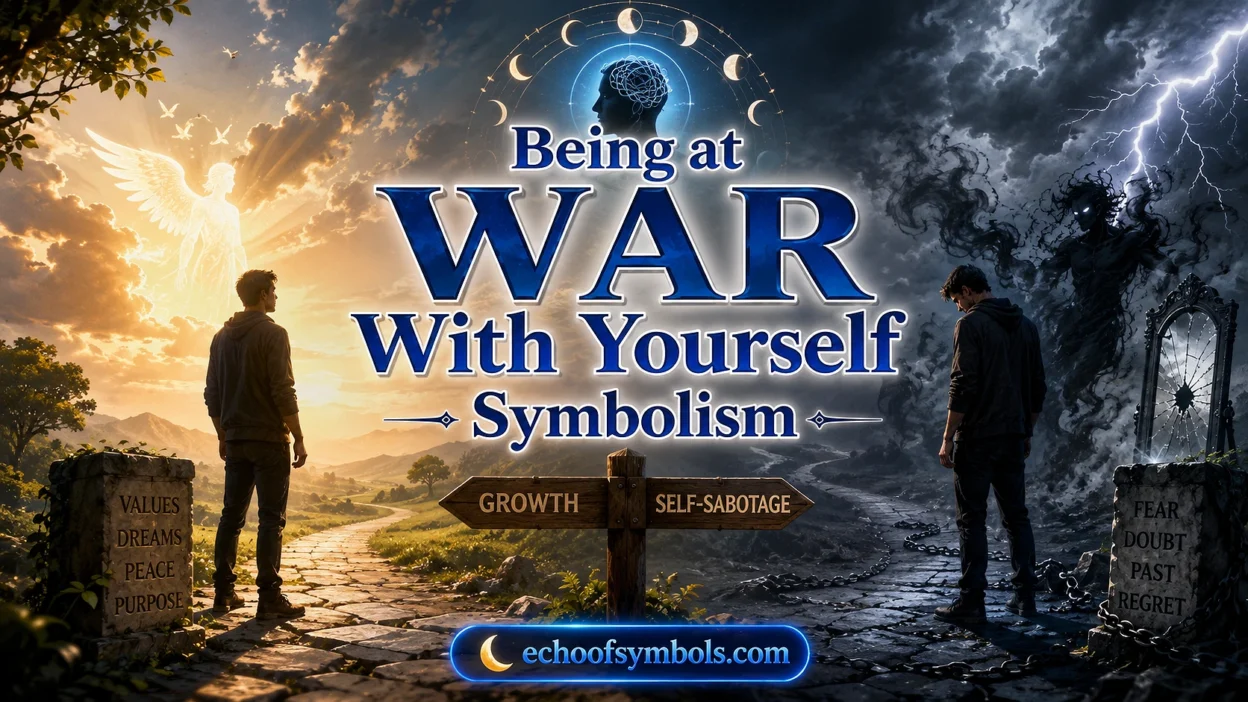
Many people experience being at war with yourself during moments of inner conflict and change. This symbolism and meaning explores the divided mind, self rejection, and emotional struggles behind choices.
These inner battles often reveal a clash between desires and actions through psychology and spirituality. Understanding this phrase can bring personal meaning to confusing feelings and experiences.
Across American life, this universal phrase reflects deep inner conflict and personal struggles. Through emotional perspective and spiritual perspective, people explore inner parts and healing.
Strange dreams and vivid dreams may show subconscious messages about inner struggle. Exploring these patterns supports self acceptance, growth, and a healthier relationship within.
Also Read This: Dinosaur Symbolism and Spiritual Meaning Explained
Quick Answer
Being at war with yourself symbolizes an internal conflict between competing desires, values, or parts of your identity. In the United States, it often points to stress, indecision, or a struggle between who you are and who you want to become. Broader spiritual views frame it as a call toward self-awareness and inner peace.
TL;DR
- This phrase describes conflict between different parts of yourself.
- It often reflects stress, guilt, or difficult decisions.
- Ancient traditions viewed inner conflict as a path to growth.
- In the USA, it is often linked to identity and mental health.
- Many spiritual paths see it as an invitation toward balance.
- Ongoing distress may be a sign to seek extra support.
What Being at War With Yourself Actually Means
Before exploring history, it helps to understand what this phrase points to. Being at war with yourself describes a feeling of internal division, where two or more parts of your mind seem to disagree. This can involve emotions, values, habits, or long-term goals pulling in different directions.
Unlike outward conflict with another person, this struggle happens entirely within. Because of that, it can feel confusing, private, and hard to explain to others.
How This Symbolism Usually Shows Up
- A strong pull between doing the “right” thing and what feels easier.
- Guilt or self-criticism following a difficult choice.
- Restlessness that comes from unresolved inner tension.
- A sense of arguing with yourself in your own thoughts.
Historical Roots and Ancient Views on Inner Conflict
The idea of an internal battle is not new. It appears across ancient philosophy, religious writing, and early psychological thought.
Ancient and Philosophical Roots
In early Greek philosophy, thinkers often described the mind as divided between reason and desire. This framing treated inner conflict as a natural part of being human, not a flaw to be ashamed of. Because of this, philosophy encouraged reflection rather than harsh self-judgment.
Religious texts across traditions also describe similar struggles. For example, some spiritual writings speak of a battle between higher intentions and lower impulses. This language shaped how later generations understood personal willpower and moral struggle.
From Moral Battle to Psychological Insight
Over time, this idea moved from purely religious language into psychological understanding. Modern psychology often frames inner conflict as competing needs, not a battle between good and evil. This shift allows for more compassion, since struggle is now seen as normal rather than shameful.
Being at War With Yourself in American Culture
In the United States, this phrase is widely used in everyday conversation, therapy language, and self-help content. Because personal growth and mental wellness are openly discussed today, this symbolism feels especially relevant.
Everyday American Associations
Americans often connect this struggle to career choices, relationships, and personal identity. It also appears frequently in conversations about mental health and emotional healing. In addition, self-improvement culture often frames this conflict as a necessary step toward growth.
A Widely Recognized Emotional Language
Because therapy and self-reflection are common topics in American media, this phrase has become part of everyday emotional vocabulary. People use it casually, but it often points to something meaningful happening beneath the surface.
Cross-Cultural and Spiritual Perspectives
While this article focuses mainly on the USA, similar ideas appear across many traditions worldwide. Inner conflict is a shared human experience, even when specific interpretations differ.
In some Eastern philosophies, inner struggle is described as imbalance between opposing forces seeking harmony. In certain spiritual teachings, this battle is viewed as an important part of the soul’s growth. Other traditions treat inner conflict as a sign that deeper truth is trying to surface.
These views are shared respectfully here, without ranking one tradition above another. Readers are encouraged to explore any specific cultural or religious teaching that resonates with them personally.
Emotional and Psychological Associations
This symbolism carries real emotional weight for many people. Understanding these feelings can help make sense of what is happening internally.
What This Inner Battle Often Signals
- A mismatch between your values and your actions.
- Unresolved fear tied to change or uncertainty.
- A need to set clearer personal boundaries.
- Emotional exhaustion from constant self-judgment.
Psychologically, this feeling often reflects competing needs rather than a true enemy within. In other words, this struggle usually points toward growth, even when it feels uncomfortable.
Common Triggers and Their Meaning
| Situation | Common Meaning in the USA | Emotional Association | Notes |
| Difficult decision | Fear of making the wrong choice | Anxiety, doubt | Often temporary and situational |
| Breaking a habit | Conflict between comfort and change | Frustration, hope | Common during self-improvement efforts |
| Identity questions | Searching for authentic self | Confusion, curiosity | Often tied to major life transitions |
| Guilt after a mistake | Struggle between self-blame and self-forgiveness | Shame, sadness | Usually eases with reflection |
| Ongoing inner tension | Deeper emotional or mental strain | Heaviness, fatigue | May benefit from added support |
Modern Usage: Language, Media, and Self-Reflection
This symbolism has expanded well beyond philosophy and religion. Today, it shows up often in everyday American conversation and media.
Where You Might See It Today
- Journaling prompts exploring inner conflict and self-growth.
- Social media posts about mental health and healing.
- Song lyrics and film dialogue describing internal struggle.
- Therapy language used to describe competing inner needs.
Interestingly, this phrase is often used with compassion today, rather than judgment. Because of this, it invites reflection instead of shame.
Misunderstandings and Controversies
As with many emotional symbols, some confusion exists around this phrase. Clearing this up helps readers use it more accurately.
Where Confusion Often Starts
One common misunderstanding treats this inner battle as a sign of weakness. In reality, most modern views see it as a normal part of being human. Another point of confusion involves assuming the struggle must be resolved instantly, when in truth, it often takes time and reflection.
It also helps to separate everyday inner tension from deeper emotional distress. If this feeling becomes constant or overwhelming, it may point to something that deserves extra attention.
How This Symbolism Has Shifted Over Time
Meaning connected to inner conflict has evolved significantly. It has moved from religious warning to compassionate self-understanding.
From Shame to Self-Compassion
Older interpretations sometimes framed inner struggle as moral failure or weakness. Today, especially in wellness spaces, it is viewed as a natural signal worth listening to. This shift mirrors a larger movement in modern psychology, which favors curiosity over self-criticism.
When It’s Simply Stress, Not a Deeper Battle
It is worth saying clearly that not every difficult moment reflects a major inner war. Everyday stress, fatigue, or a hard decision can create temporary tension. If your experience feels situational rather than constant, that explanation is completely valid.
Choosing a symbolic interpretation does not require ignoring practical causes. Many people hold both views at once, honoring the emotional depth while addressing real-life stress.
How to Reflect on This Feeling
If you want to explore what this inner conflict means for you personally, a few simple questions can help.
- Which parts of yourself feel like they disagree right now?
- What need might each side be trying to protect?
- Is this feeling temporary, or has it lasted a long time?
- Would speaking with someone you trust bring relief?
There are no required answers here. The goal is gentle reflection, not judgment or pressure.
FAQs
What does being at war with yourself mean?
Being at war with yourself means experiencing inner conflict where thoughts, emotions, and actions feel divided. It often reflects a clash between desires and actions during difficult moments.
What is the symbolism and meaning of inner battles?
The symbolism and meaning of inner battles represents personal struggles, deep inner conflict, and the search for balance between different personality parts.
How does psychology explain being at war with yourself?
In psychology, being at war with yourself can reflect a divided mind, inner critic, and unresolved emotions affecting decision making, behavior, and self-image.
Can strange dreams reveal subconscious inner conflicts?
Yes, strange dreams and vivid dreams may reveal subconscious thoughts through dream symbolism, showing hidden fears, emotions, and personal struggles.
How can someone overcome inner struggle and find growth?
People can overcome inner struggle through self compassion, self acceptance, and emotional awareness while working toward personal transformation journey and healing.
Conclusion
Understanding being at war with yourself reveals how inner conflict can shape emotions, choices, and personal growth. Through self compassion, self acceptance, and emotional awareness, people can transform inner struggle into healing. This journey toward personal transformation journey creates clarity, balance, and a deeper connection with the self.