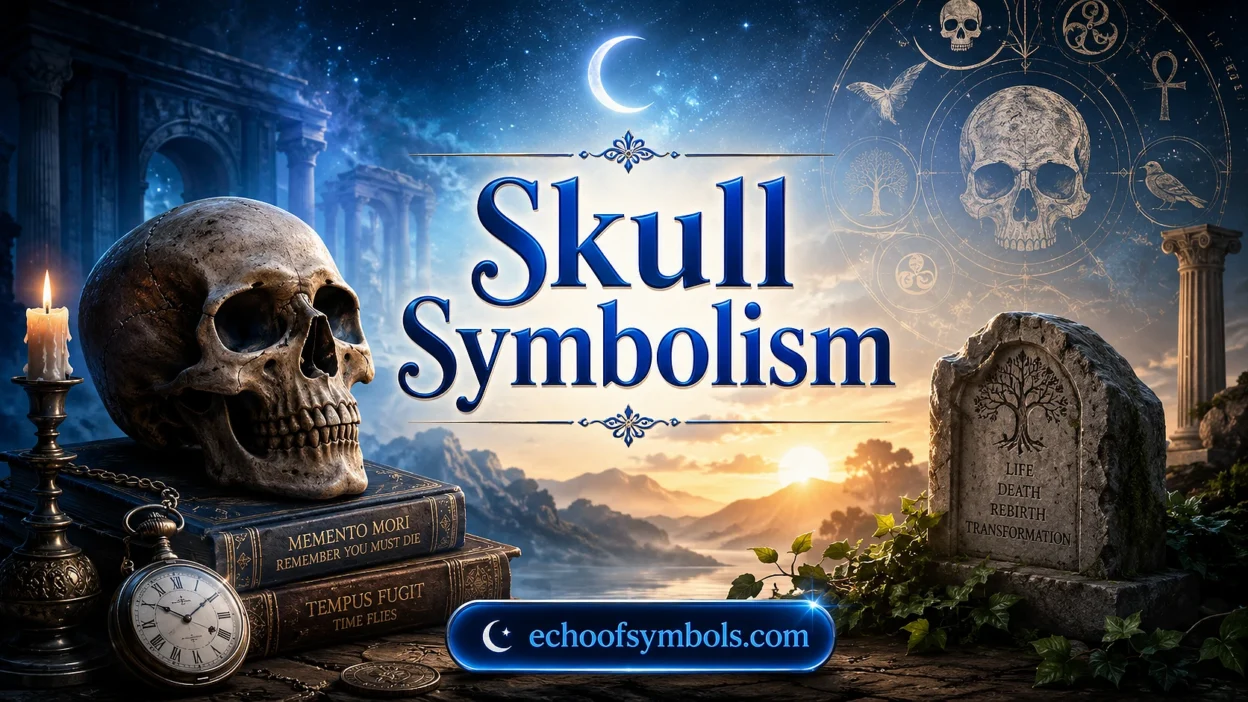
Skull symbolism has fascinated people across cultures, revealing profound ideas about mortality, rebirth, and transformation. Beyond representing death symbolism, the human skull reflects wisdom, courage, strength, resilience, and the enduring soul.
Many traditions connect skull spiritual meaning with the cycle of life, birth and death, impermanence, spiritual awakening, and the spirit world. Understanding skull meaning helps uncover deeper truths about human existence, identity, personal identity, and lasting symbolic meaning.
Today, the skull symbol appears in skull tattoos, skull jewelry, fashion, modern culture, American culture, Halloween, Day of the Dead, Día de los Muertos, decorative art, and the skull emoji, reflecting evolving cross-cultural symbolism.
Throughout human history, ancient civilizations embraced skull iconography, religious symbolism, cultural symbolism, and mythology within sacred rituals and religious traditions. This guide explores honoring ancestors, afterlife, truth, liberation, overcoming fear, mortality awareness, and the timeless universal symbol that continues inspiring people worldwide.
Also Read This: Two Doves Symbolism and Spiritual Meaning
Quick Answer
In skull symbolism and spiritual meaning, this image often represents mortality, transformation, and inner strength in the United States. Broader traditions also connect it to protection, wisdom, and honoring those who have passed. The meaning usually points toward reflection rather than fear alone.
TL;DR
- Skulls often symbolize mortality and life’s fragile nature.
- They also represent transformation, courage, and inner wisdom.
- In the USA, skulls appear widely in fashion and tattoos.
- Ancient cultures viewed skulls as sacred, not only frightening.
- Many traditions use skulls to honor ancestors and memory.
- Modern use includes holidays, decor, and personal identity symbols.
What the Skull Symbol Actually Represents
Before exploring history, it helps to understand how the skull appears and why it carries such weight. A skull is the bare structure beneath a face, stripped of skin and expression. Because it strips away individual identity, many see it as a symbol of what remains constant beneath the surface.
Its stark, bony shape also makes it easy to recognize instantly. This visual simplicity is part of why the symbol has traveled across so many cultures.
How the Symbol Usually Appears
- A bare human skull shown alone or with crossed bones.
- Decorated skulls painted with bright colors or patterns.
- Skull imagery paired with flowers or candles.
- A skull used quietly as a small piece of jewelry.
Historical Roots and Ancient Beliefs About Skulls
Skull symbolism did not begin recently. It stretches back thousands of years, appearing in some of humanity’s earliest spiritual practices.
Ancient and Pre-Christian Roots
In ancient cultures across the world, skulls were sometimes kept and honored rather than feared. Some early societies believed the skull held a person’s spirit or life force even after death. Because of this belief, skulls were often treated with reverence instead of dread.
In parts of ancient Europe, skull imagery also appeared in warnings and boundary markers. This mix of respect and caution shaped how later generations viewed the symbol.
Spiritual and Symbolic Use
Over time, many traditions began using the skull to represent transformation rather than only endings. In Tibetan Buddhist practice, skull imagery is sometimes used to encourage reflection on impermanence. This shift reflects a broader pattern of viewing death as part of a larger spiritual cycle.
Skull Symbolism in the USA
While skull symbolism has ancient roots, it holds a distinct place within American culture today. Because it touches on both fear and rebellion, the image carries strong personal meaning for many people.
Everyday American Associations
In the United States, skulls are often linked to individuality, edge, and personal freedom. They also appear frequently in symbols of courage, especially within motorcycle and outdoor communities. In addition, skull imagery is closely tied to remembrance during certain holidays and personal tributes.
Skulls in National and Cultural Life
Beyond personal meaning, skulls also appear often in American fashion, music, and design. Halloween in particular has cemented the skull as a familiar seasonal image nationwide. This steady presence keeps the symbol relevant across generations.
Cross-Cultural and Spiritual Perspectives
While this article focuses mainly on the USA, skull symbolism is not limited to one culture. Many traditions across the world share deep respect for this image, even when specific meanings differ.
In Mexican tradition, decorated skulls play a central role in Dia de los Muertos, honoring loved ones who have passed. In Tibetan Buddhist teaching, skull imagery encourages reflection on impermanence and letting go. Other spiritual paths view the skull as a quiet reminder to live fully and honestly.
These views are shared respectfully here, without ranking one tradition above another. Readers are encouraged to explore any specific cultural or religious teaching that resonates with them personally.
Emotional and Psychological Associations
Beyond history, skulls carry a strong emotional pull for many people. Their presence often triggers feelings that go deeper than simple discomfort.
What Skull Symbolism Often Signals
- A reminder that time and life are limited.
- A desire to face fear instead of avoiding it.
- A sense of strength found through past struggles.
- A quiet nudge to focus on what truly matters.
Psychologically, symbols like the skull often act as mirrors for personal reflection. In other words, connecting with this image may reflect a need to process fear, rather than a fixed outside warning.
Skull Symbolism at a Glance
| Context | Common Meaning in the USA | Typical Emotional Association | Notes |
| Plain white skull | Mortality, reflection | Awareness, calm | Most traditional and recognized form |
| Decorated or painted skull | Remembrance, celebration | Honor, connection | Common in memorial traditions |
| Skull and crossbones | Danger, warning | Caution, alertness | Widely used as a safety symbol |
| Skull tattoo | Strength, resilience | Empowerment, identity | Popular personal choice in the USA |
| Skull in dreams | Transition or ending | Uncertainty, change | Meaning depends on dream context |
Modern Usage: Tattoos, Decor, and Pop Culture
Skull symbolism has expanded well beyond its early spiritual roots. Today, it shows up in casual and creative spaces across American life.
Where You Might See It Today
- Skull tattoos representing resilience, memory, or rebellion.
- Halloween decorations featuring playful or stylized skull designs.
- Fashion items like jewelry, patches, and graphic prints.
- Social media content about courage, mortality, or self growth.
Interestingly, skull imagery often shifts tone depending on setting, feeling either somber or lighthearted. Because of this range, the symbol still feels relevant across very different audiences.
Misunderstandings and Controversies
As with many spiritual symbols, some confusion exists around skull meaning. Understanding this helps readers avoid mixing up ideas that are not accurate.
Where Confusion Often Starts
One common misunderstanding involves assuming skulls only represent danger or negativity. In reality, many traditions treat the image as respectful and reflective instead. Another point of confusion involves skull imagery used in harmful or hateful contexts, which stands apart from its traditional, respectful meanings.
It also helps to separate spiritual interpretation from simple decoration. Not every skull image carries a deep personal message.
How Skull Symbolism Has Shifted Over Time
Meaning connected to symbols rarely stays completely fixed. Instead, it evolves slowly as culture and communication styles change.
From Sacred Object to Everyday Icon
In earlier centuries, skulls were often treated as sacred objects tied closely to ritual and remembrance. Today, especially in fashion and self expression, the skull has become a more casual and personal icon. This shift mirrors a larger pattern in modern culture, which often blends solemn history with everyday style.
When It’s Simply an Image, Not a Sign
It is worth saying clearly that not every skull image needs a hidden message. Sometimes a skull is simply part of a design, costume, or seasonal decoration. If you prefer a practical explanation, that view is equally valid.
Choosing a spiritual interpretation does not require rejecting the simple one. Many people hold both views at once, enjoying the image while also reflecting on its deeper meaning.
How to Reflect on Skull Symbolism
If you want to explore what the skull might mean for you personally, a few simple questions can help guide that reflection.
- Are you facing a fear you have been avoiding?
- Do you feel drawn to reflect on life’s bigger picture?
- Is there something from the past you want to honor?
- Does this symbol appear during a season of change?
There are no required answers here. The goal is gentle reflection, not a strict prediction about the future.
FAQs
What is the skull symbolism and skull spiritual meaning?
Skull symbolism represents mortality, rebirth, transformation, spiritual awakening, and the enduring soul, reminding us about the cycle of life and personal growth.
Why is the human skull considered a powerful universal symbol?
The human skull is a universal symbol of death symbolism, impermanence, wisdom, strength, resilience, and the shared journey of human existence.
How does the skull symbol appear in different cultures and religions?
The skull symbol appears through religious symbolism, cultural symbolism, mythology, Christian symbolism, Hinduism, Buddhism, Aztec symbolism, Mayan symbolism, Celtic symbolism, and Day of the Dead traditions.
What does a skull tattoo or skull jewelry symbolize today?
Modern skull tattoos and skull jewelry often express courage, truth, overcoming fear, personal identity, fashion, modern culture, and lasting symbolic meaning.
How is the skull emoji different from traditional skull meaning?
The skull emoji is commonly used in modern symbolism for humor or surprise, while traditional skull meaning reflects afterlife, honoring ancestors, mortality awareness, and deeper spirituality.
Conclusion
Skull symbolism goes far beyond death symbolism, revealing timeless lessons about mortality, rebirth, transformation, wisdom, and the enduring soul. Across cultural symbolism, religious symbolism, and modern culture, the skull symbol continues inspiring reflection on human existence, personal growth, afterlife, and the cycle of life. By understanding the deeper skull spiritual meaning and symbolic meaning, you can appreciate why this universal symbol remains meaningful across generations and traditions.