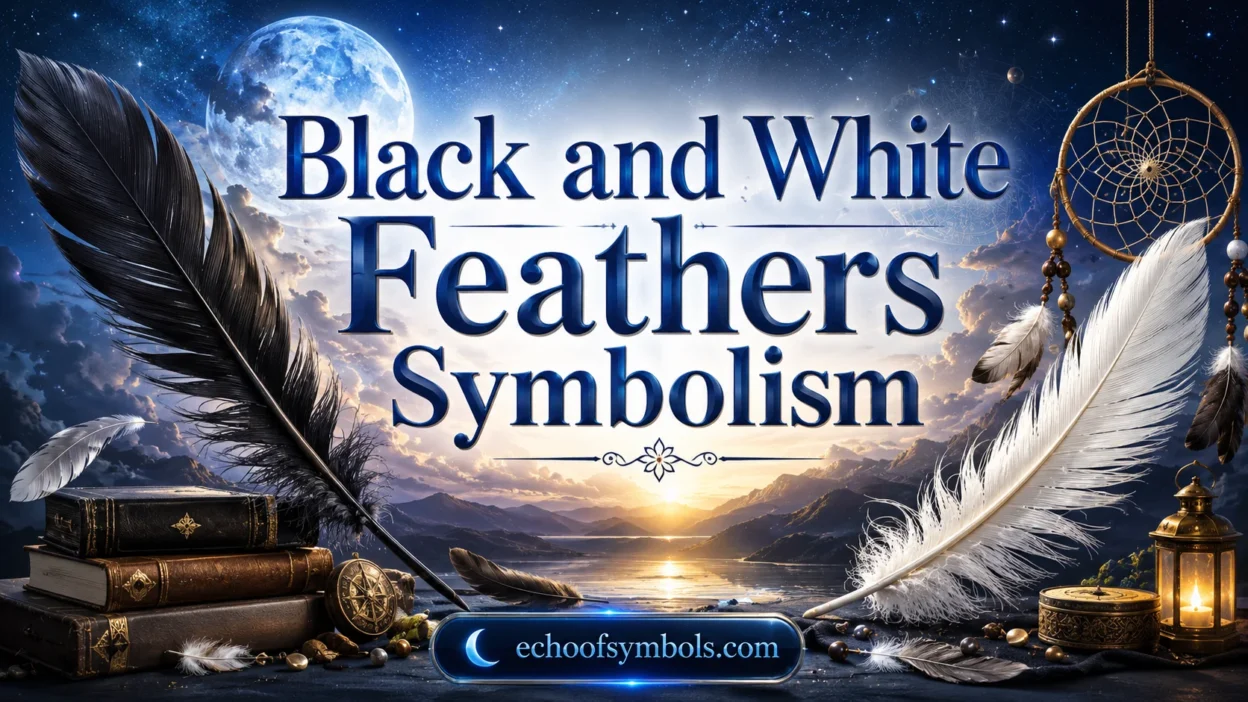
Have you ever discovered black and white feathers and wondered about their symbols and spiritual meaning? Many people connect feather symbolism with spiritual symbolism, balance, harmony, and duality in everyday life.
These remarkable symbolic feathers often represent the union of opposites, light and dark, purity, mystery, protection, and peace. They may also inspire hope, spiritual awakening, personal growth, and spiritual growth through meaningful experiences.
Many spiritual interpretations describe finding a feather as one of many spiritual signs, angel signs, and spiritual messages. Whether a black feather meaning, white feather meaning, two-toned feather, dual-colored feather, or black-and-white feather appears, many believe it offers divine guidance, guidance, and a message from the universe.
Across cultures, religions, spiritual traditions, and American beliefs, these bird feathers symbolize inner balance, divine protection, spiritual connection, transformation, and new beginnings. Discover how these feather messages reveal hidden meaning, encourage self-discovery, strengthen intuition, and support your spiritual journey toward higher consciousness, self-awareness, and inner peace.
Also Read This: Symbolism and Spiritual Meaning of Jumping Spider
Quick Answer
In the United States, the symbols and spiritual meaning of black and white feathers represent the ultimate balance of opposing life forces, much like light and shadow. They typically symbolize a message of hope, protection, and the promise that harmony is returning to your life.
TL;DR
- Dual colors symbolize the perfect balance of light and dark forces. ⚖️
- Many Americans view them as comforting signs of spiritual protection and guidance. 🛡️
- Historically, these feathers represent the union of heaven and earth. 🌍
- Modern seekers use them in home decor, tattoos, and mindfulness rituals. 🧘
- They remind us that challenges and blessings always work together for good. 🕊️
Defining the Symbols and Spiritual Meaning of Black and White Feathers
Before diving into history, we must look at how this beautiful symbol actually appears in nature. A black and white feather can show up in many different patterns and textures. For instance, it might have a dark tip with a snowy base, or bold, zebra-like stripes.
Because of this physical contrast, the visual impact is immediate and powerful. In the United States, people often find these feathers while walking in local parks, forests, or even backyards. Consequently, the sudden contrast of dark and light shades immediately grabs our attention and sparks curiosity.
Visual Patterns in Nature
- Striated patterns show a gradual transition, symbolizing smooth personal growth and daily progress. 📈
- Speckled feathers represent the small joys scattered throughout our difficult times. ✨
- Split-color feathers show a sharp divide, reminding us to make clear, decisive choices. ⚡
- Fluffy white bases with dark tips suggest that our worries are grounded in peace. ☁️
The Chemistry of Color
- Melanin produces the deep black shades, which physically strengthens the feather structure. 💪
- Unpigmented areas create the pure white spaces, reflecting all visible light. 🌟
- Stronger dark edges protect the bird from wear and tear during long flights. 🦅
- The balance of these colors allows birds to remain camouflaged and safe. 🌲
Historical Origins and the Evolution of Feather Lore
To truly understand this symbol, we must look back at how ancient civilizations viewed birds. For thousands of years, humans have looked at the sky with a sense of deep wonder. Birds were seen as divine messengers because they could easily travel between the earth and the heavens.
As time passed, different cultures began to write down their own meanings for specific feather colors. During the Middle Ages, feathers were often used as writing tools, linking them directly to communication. Today, we still carry these ancient ideas with us, even if we do not realize it.
Ancient Mythological Roots
- Egyptian Ma’at used a feather to weigh the hearts of souls seeking eternal peace. ⚖️
- Greek myths linked spotted feathers to Argus, the watchful giant with many eyes. 👁️
- Celtic priests wore feather cloaks to journey safely into the spiritual realms. 🌌
- Nordic legends associated feather transformations with the goddess Freya’s magical flight. 👑
Pre-Christian Beliefs
- Roman augurs watched bird flight paths to predict the outcomes of major battles. 🛡️
- Early European tribes viewed bi-colored feathers as sacred symbols of the changing seasons. 🍂
- Germanic folklore held that finding a dark feather meant a secret was unfolding. 🗝️
- Ancient farmers placed striped feathers in fields to bless the upcoming spring harvest. 🌱
The Modern American Perspective on Feather Symbolism
In the United States, feather symbolism has found a unique home in our modern, fast-paced culture. Many Americans use these natural symbols to find moments of peace in busy cities. Because our society values individual journeys, finding a feather is often seen as a deeply personal message.
In addition, American media and literature have long used feathers to represent freedom and lightheartedness. From classic films to popular novels, the image of a drifting feather resonates with our desire for liberty. Consequently, the black and white feather has become a popular emblem of hope across the nation.
Cultural Integration
- Modern mindfulness apps encourage users to focus on natural objects like feathers. 📱
- American literature often uses feathers to show a character’s spiritual awakening. 📖
- Local community gardens sometimes display feather art to promote peace and unity. 🌻
- Popular movies use drifting feathers to symbolize the beautiful mystery of destiny. 🎬
Everyday Associations
- Many people keep found feathers on their car dashboards for safe travels. 🚗
- Creative writers keep them on their desks to inspire honest, balanced storytelling. ✍️
- Families use feather motifs in nursery rooms to invite gentle, protective energy. 👶
- Hikers collect them as physical souvenirs of their personal triumphs on trails. 🥾
Cross-Cultural and Spiritual Meanings Around the Globe
While the American view is highly personal, other cultures offer rich, collective meanings for these feathers. In Eastern philosophies, the blend of black and white perfectly mirrors the concept of Yin and Yang. This idea teaches us that opposing forces are actually complementary and interconnected.
Similarly, African traditions often view bi-colored feathers as signs of ancestral guidance and wisdom. By looking at these global perspectives, we gain a deeper appreciation for the feather we find on our path. It connects us to a global tapestry of human belief and spiritual curiosity.
Yin and Yang Philosophy
- The black portion represents the receptive, quiet, and reflective feminine energy. 🌙
- The white portion represents the active, bright, and expressive masculine energy. ☀️
- Together, they show that light cannot exist without the dark shadow. ☯️
- The swirling pattern suggests that life is constantly moving and changing form. 🔄
Global Spiritual Traditions
- Shamanic practices use striped feathers to bridge the physical and spiritual worlds. 🌀
- Shinto beliefs associate unique feathers with the presence of helpful nature spirits. 🦊
- Polynesian sailors historically used feather patterns to navigate across vast, open oceans. ⛵
- European folklore suggests a bi-colored feather brings balance to a divided home. 🏡
Emotional and Psychological Associations with Dual Colors
From a psychological standpoint, the colors black and white trigger very specific reactions in our minds. Black often represents the unknown, mystery, or the subconscious mind where our hidden feelings lie. On the other hand, white represents clarity, open space, and conscious awareness.
When these two colors meet on a single feather, they create a sense of psychological wholeness. This visual harmony can help ease anxiety by reminding us that life is rarely just black or white. Instead, it is a beautiful mix of both, working together to shape our unique story.
Psychological Balance
- The dual colors help us accept both our strengths and our personal flaws. 🤝
- Viewing the contrast can calm a mind that is stuck in worries. 🧠
- It encourages us to find a middle ground during difficult family arguments. 💬
- The pattern reminds us that sad times always lead back to joy. 🌅
Emotional Healing
- Finding one can bring deep comfort to someone grieving a major loss. 🤍
- It serves as a gentle reminder to practice self-care during busy weeks. 🛁
- The feather helps release the pressure of trying to be completely perfect. 🎈
- It encourages us to embrace the mysteries of our future with hope. 🌟
Modern Digital Culture, Home Decor, and Personal Identity
In the age of social media, the black and white feather has become a highly visual trend. People love to share photos of their feather finds on platforms like Instagram and Pinterest. These images often accompany posts about mental health, spiritual growth, and peaceful living.
Furthermore, this symbol has heavily influenced modern interior design and fashion. Clean, minimalist homes often use feather prints to add a touch of organic warmth to modern spaces. It shows that even in a digital world, we still long for a physical connection to nature.
Social Media Trends
- Users share feather photos using hashtags focused on daily gratitude and peace. 📸
- Digital artists create beautiful wallpapers featuring stylized, high-contrast feather designs. 🎨
- Influencers use the feather emoji to signify healing and spiritual alignment. 🕊️
- Online communities gather to share stories of timely feather discoveries in nature. 💬
Home Decor and Fashion
- Minimalist living rooms feature large, framed prints of black and white feathers. 🖼️
- Delicate silver jewelry often incorporates striped feather charms for daily protection. 💍
- Dreamcatchers made with bi-colored feathers are popular gifts for new homeowners. 🕸️
- Casual clothing brands use simple feather graphics to promote eco-friendly mindsets. 🌱
Misunderstandings, Misuse, and Shifting Meanings
As with any popular symbol, misconceptions can easily arise over time. Some people mistakenly believe that the black in the feather represents bad luck or a negative omen. However, in traditional symbolism, black is actually a powerful color of protection and deep self-reflection.
Another important topic is the respectful treatment of wildlife and cultural items. In the United States, federal laws protect certain birds, making it illegal to keep their feathers. Understanding these rules helps us appreciate our finds responsibly without harming local ecosystems or ignoring cultural boundaries.
Common Misconceptions
- Thinking the dark shade indicates coming illness or general bad luck. ❌
- Believing that only rare, exotic birds carry these spiritually meaningful feathers. 🐦
- Assuming that a feather must be kept physically to retain its blessing. 🤲
- Confusing purely natural markings with signs of a sick or injured bird. 🩺
Legal and Ethical Guidelines
- The Migratory Bird Treaty Act protects many native North American bird species. 🦅
- It is best to take a photo of your find and leave it in nature. 📷
- Avoid buying cheap, mass-produced feathers that are harvested using unethical practices. 🛒
- Respect Indigenous traditions by not mimicking sacred ceremonial items for quick profit. 🌾
How the Symbolic Meaning Has Shifted Over the Decades
The way we view feathers has changed significantly over the last several decades. In the mid-twentieth century, feathers were often viewed simply as beautiful natural objects or craft materials. However, the rise of the wellness movement in the late twentieth century revived their spiritual status.
Today, we look at these symbols through a lens of personal empowerment and mental health. Instead of viewing them as superstitious fortunes, we see them as tools for self-awareness and quiet meditation. This shift shows how ancient wisdom can adapt to help us face modern, everyday challenges.
Decades of Change
- In the 1970s, feathers were widely celebrated as symbols of peace and rebellion. ✌️
- The 1990s focused heavily on using feathers in bohemian home design trends. 🏺
- By the 2010s, they became viral symbols for personal transformation on social media. 💻
- Today, they are deeply integrated into daily self-care and mental health practices. 🧘
The Future of the Symbol
- Future generations will likely continue using the symbol to promote environmental preservation. 🌍
- Digital spaces will keep finding new ways to animate and share feather art. 👾
- The focus will continue shifting toward mindful, eco-friendly interactions with local wildlife. 🌳
- It will remain a timeless anchor for those seeking quiet moments in life. ⚓
FAQs
What Do Black and White Feathers Mean Spiritually?
The black and white feathers carry deep symbols and spiritual meaning, representing balance, harmony, duality, and the union of opposites. Many people believe they reflect light and dark, encourage inner balance, support spiritual growth, and offer divine guidance during important moments.
Is Finding a Black and White Feather a Spiritual Sign?
Many spiritual interpretations consider finding a feather to be one of the meaningful spiritual signs, angel signs, and feather messages. A black-and-white feather may be viewed as a message from the universe, reminding you to trust your intuition, embrace new beginnings, and continue your spiritual journey.
What Is the Difference Between Black Feather Meaning and White Feather Meaning?
The black feather meaning is often linked with mystery, protection, strength, and personal reflection, while the white feather meaning commonly symbolizes purity, peace, hope, and divine protection. Together, they create powerful feather symbolism that reflects transformation, spiritual awakening, and spiritual connection.
How Do Different Cultures View Black and White Feathers?
Across many cultures, religions, spiritual traditions, and American beliefs, black and white feathers are respected as universal symbols carrying hidden meaning and sacred symbolism. They are frequently associated with wisdom, faith, higher consciousness, and guidance along a meaningful life path.
Can Black and White Feathers Appear During Major Life Changes?
Many people notice black and white feathers during life changes, significant changes, or periods of self-discovery and personal transformation. Whether you find a two-toned feather or dual-colored feather, it may encourage self-awareness, hope and healing, positive energy, and confidence throughout your awakening journey toward your destiny.
Conclusion
Whether you discover black and white feathers on a path, in your backyard, or during a meaningful encounter, their symbols and spiritual meaning continue to inspire many people. Their rich feather symbolism reflects balance, harmony, transformation, spiritual awakening, and divine guidance, encouraging a deeper spiritual connection with yourself and the universe.
Across cultures, spiritual traditions, and American beliefs, these meaningful bird feathers remain powerful spiritual signs that support personal growth, self-discovery, inner peace, and higher consciousness. By reflecting on their hidden meaning, you can better understand your life path, embrace new beginnings, and move forward with hope, faith, and lasting wisdom.